
Clarification of Exhaust Pressure Measurements and Airflow Balancing
PURPOSE
This bulletin clarifies the exhaust requirements listed in the VectraElite Engineering Data Sheet (EDS) and Installation Manual. It addresses a common misunderstanding regarding static pressure, velocity pressure, and the proper method for verifying exhaust airflow.
TECHNICAL CLARIFICATION
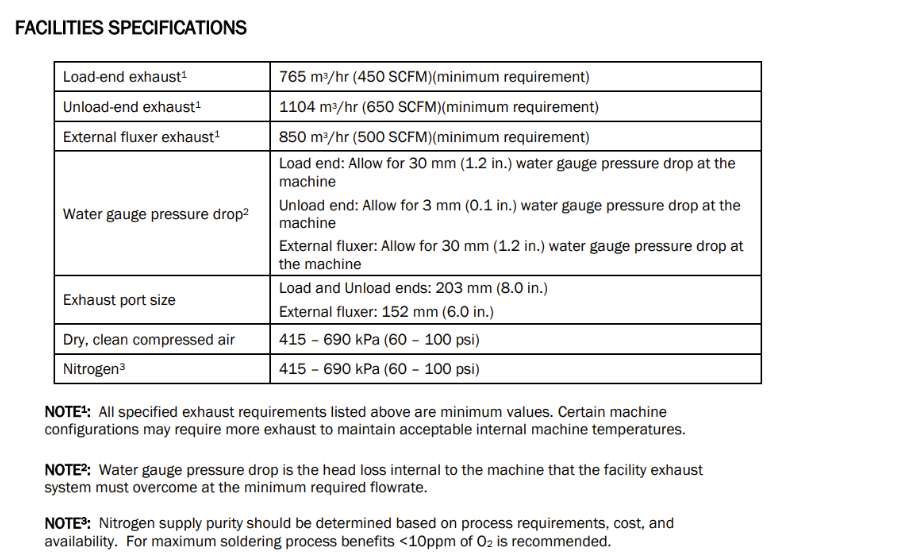
The pressure values listed in the Engineering Data Sheet (EDS) represent the water gauge pressure drop (head loss) associated with the internal plumbing and components of the machine.
These values are used when sizing the exhaust blower. The system designer must account for the machine's internal head loss along with other system losses, including duct length, tees, elbows, and other ductwork restrictions, to properly size the exhaust blower.
The EDS pressure values are NOT static pressure measurements to be used as minimum field measurement requirements.
STATIC PRESSURE vs. VELOCITY PRESSURE
It is important to understand the difference between these two measurements:
- Static Pressure: Measures the resistance encountered by air as it travels through the ductwork. Static pressure alone does not indicate the actual airflow volume.
- Velocity Pressure: Measures the pressure associated with the movement of air through the ductwork and is used to determine exhaust airflow.
The primary concern when verifying exhaust performance is achieving the required airflow (SCFM), not matching the static pressure values listed in the EDS.
RECOMMENDED MEASUREMENT PROCEDURE
To properly verify exhaust airflow:
- Obtain a Pitot tube and manometer.
- Measure velocity pressure in the exhaust ductwork.
- Follow the exhaust airflow measurement procedure documented in the VectraElite Installation Manual.
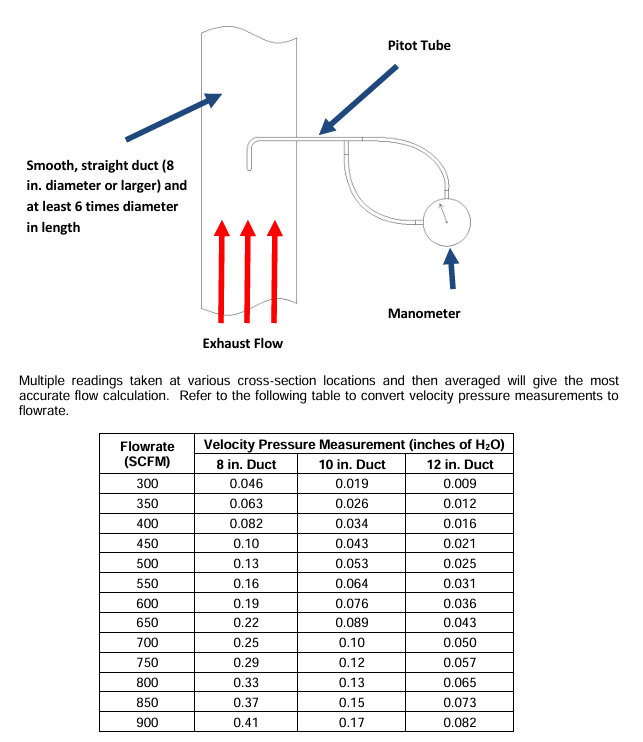
- Use the velocity pressure reference values provided in the Installation Manual for the corresponding duct sizes to determine airflow.
- When it comes to measuring exhaust flow, velocity pressure is the one that matters. This is measured with a simple pitot tube and manometer and the process is documented in the Installation Manual. Below is an excerpt from the manual showing the velocity pressure numbers relative to flowrate in different size ducts. I recommend obtaining a pitot tube and manometer and measuring for exhaust flow just as it is described in the manual.
- Verify that each exhaust connection meets its required minimum airflow.
Do not attempt to determine whether the machine has sufficient exhaust by comparing field static pressure readings directly to the pressure drop values in the EDS.
EXHAUST BALANCING GUIDELINES
Engineering has confirmed that a proportional increase in exhaust airflow is acceptable but may not be necessary. There is no internal airflow dynamic that makes proportional balancing critical.
When balancing the exhaust system, prioritize the following:
- External Fluxer Exhaust Port: High priority. Helps prevent fumes from escaping the machine.
- Unload End Machine Port: High priority. Helps prevent fumes from escaping the machine.
- Load End Machine Port: Lower priority when an external fluxer is installed. Its primary purpose is heat extraction to keep internal machine components cool.
As long as the minimum airflow requirements are met at each port, dampers can be adjusted and airflow balanced according to the machine configuration. The highest priority should be maintaining sufficient exhaust to prevent fumes from escaping.
Additional exhaust capacity provides a buffer for heavier loading and helps reduce heat buildup inside the machine, which can improve the lifespan of internal components.
KEY TAKEAWAYS
- The EDS pressure values represent machine head loss used for exhaust blower sizing.
- Static pressure and velocity pressure are not interchangeable.
- Static pressure does not establish actual exhaust airflow.
- Velocity pressure, measured with a Pitot tube and manometer, is the appropriate measurement for verifying exhaust flow.
- Follow the Installation Manual measurement procedure.
- Prioritize the Fluxer and Unload End exhaust ports when balancing airflow.
- Minimum airflow requirements must be maintained at every exhaust port.