Introduction
During solidification of a solderjoint part of the solder on the coldest part of the topside fillet will already be solidified, while the bulk of the solder in the joint will shrink by about 4%.
As a result of that this already solidified upper part will rupture from the remaining fillet.
Next a model of such a joint will be described.
Reason for topside fillet cracking during the soldering process
During the formation of the joint, the solder wicked up creating a high topside fillet.
Directly after the fillet has reached its highest point, the board separates from the solder wave and the solder starts to solidify. The solder solidifies first at its coldest spot, which is at the topside of the lead.
During the solidification of the solder, heat is still flowing to the lead inside the joint, due to the solidification energy that is emitted from the solder as the solder in the joint changes from liquid to solid.
The copper lead will therefore still expand as the bulk of the solder in the joint is in the beginning of its solidification.
In this phase the lead is still elongating, while the main part of the solder in the joint starts to reduce its volume by 4% as it transforms from liquid to solid.
Since part of the solder on top of the fillet is already solidified, a tensile and shear force will act on the boundary of this solidified part as the remaining bulk of the solder in the joint starts to shrink and the lead still expands. This will finally cause the cracks we see on such joints. The crack is at the point where the already solidified solder separates from the bulk of the solder that is still solidifying.
Model of cracked topside fillet joint
Next figure shows on the left-hand side a model of cross-section of a cracked topside fillet. On the right-hand side a detail from a part of the cracked area is given. 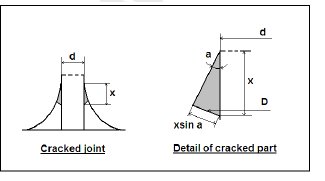
The annotations in this figure should be read as follows:d = lead diameter
x = position of the rupture on the lead measured from the fillet topside
a = the topside fillet angle α
D = d + x.sinα.cosα
Remark: From the solder joint only the topside fillet is shown. Above the dotted line is the remaining lead part with the component body (not shown). Below the base line is the remaining joint in the hole barrel and the solder side fillet (not shown).
Comparing different situations
The crack or rupture in the top of the solder fillet will be at a position where the strength of the solder adhering to the lead equals the strength of the solder at the ruptured surface.
During the crack formation the tensile strength of the ruptured surface is much weaker than the strength of the already solidified solder. Therefore a factor f should be used, which means that the ruptured surface has f-times the strength of the solidified solder at the lead.
The fraction f is < 1 since solidified solder is stronger than solidifying solder.
Under these conditions the following equations can be used:
The strength of solid solder at the cracked area at the top of the lead can be expressed as:
Fc = π.x.sinα(d + x.sinα.cosα)
The strength of the liquid/pasty solder at the cracked area can be expressed as:
Fl = π.d.x
Since we assume that Fl = f.Fc we got:
f.d = sinα(d + x.sinα.cosα)
From this equation we get:
x = d(f/sinα - 1) / sinα.cosα and f = sinα((x.sinα.cosα)/d + 1)
d = lead diameter
x = length of the solidified solder layer at the lead above the rupture, measured from the top of the solder fillet
α= angle between lead and topside fillet
Fc = solder strength of the 'cold' solder
Fl = solder strength of the 'liquid' solder
f = compensation factor for the weaker strength of the liquid solder at the crack surface
When x is known, e.g. from measurements on a cross section of the joint, then itis possible to calculate the strength compensation factor f for the ruptured area:
Example
Measured from a cross-section we found d = 0.4 mm, x = 0.3 mm and α = 13°
f = sinα((x.sinα.cosα)/d + 1)
Giving:f = 0.224951054 × ((0.3 × 0.224951054 × 0.974370064 / 0.4 +1)) =0.26
Conclusion
Although the calculation model used is more or less 'empirical', it can be used for comparing different situations.
With this calculation model we are able to get a better understanding of the effects that play a role in the crack formation. By using the calculation formula for the determination of the factor f, we can get a better knowledge on how different alloys might behave in this respect, since we can use this factor for comparison.

ITW EAE Support Center