Introduction
Blowholes in through hole joints are the result of barrel cracking in combination with outgassing humidity from the board material.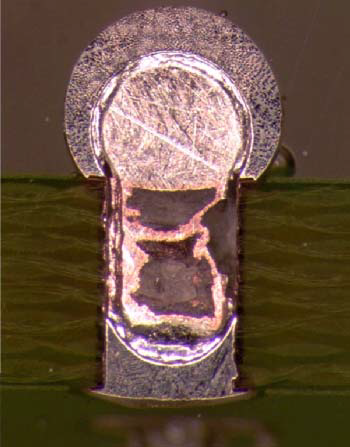
Due to the higher process temperatures for lead-free soldering, the risk of barrel cracking increases.
The cause and mechanism of blowholes will be explained.
Cause for blowhole formation
During the soldering process the board comes at high temperatures. In the direct surroundings of the through hole joints the temperature comes at or close near the melting temperature of the solder. This temperature of 217 °C for SAC solder is well above the boiling temperature of water. So if humidity traces are present in that environment, these may be able to transform to steam with a locally high pressure.
In a well-soldered joint the solder has wicked up at least to the upper-edge of the top solderpad. This means that the temperature at this spot has been at least the melting temperature of the solder alloy that is used. At the moment that the board leaves the solderwave, the heat supply from the solderwave to the board stops. The heat flow to the joint surroundings however will still increase for a while.
The reason for that is that the solidification energy from the solder in the joint will emit its heat to the surrounding environment. Only after the solder is completely solidified and the solidification energy is emitted the temperature of the joint and its surroundings will drop.
Due to the big difference in thermal expansion between the board material (inmost cases epoxy FR 4) and the copper barrel, there is a big tensile load on the copper barrel during this process.
If the copper barrel plating is not able to withstand this load it can crack or tear. Often failures in the drilling or hole plating process are responsible for an improper barrel thickness.
Such boards are more vulnerable for the barrel cracking phenomenon.

ITW EAE Support Center