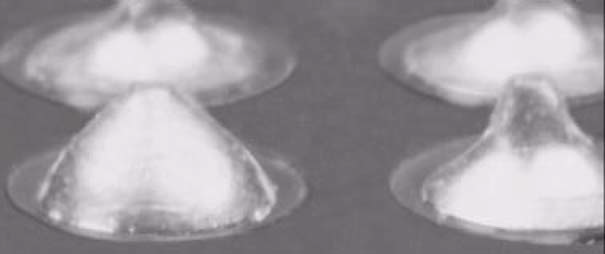
Identical joints with different joint shapes, fat and standard.
The reliability (mechanical and electrical) of a fat joint is the same as for the commonly shaped joint. One should therefore never rework such joints to transform them into the common shape, as this will do more harm than good.
In wave soldering with boards without solder resist, one will never find fat joints because due to the surface tension of the liquid solder, the excess solder, which is drawn from the solderbath while the joint leaves the wave, will be drained to the tracks which are connected to the joint. Excess solder at a joint where the tracks are covered with solder resist, will stay on that joint because there is no way for the solder to be drained. Such a fat joint is however a perfect joint if there is evidence that there is a component lead in the solder, (e.g. by comparing to adjacent joints or looking to the contour edges of the connecting parts), since the solder in wave soldering will only adhere to a solder connection when the solderability of this connection is perfect.
When the solderability of a joint is not perfect, than in wave soldering such a joint will show non- or imperfect wetting and will never give a fat joint. Thus, a fat joint in wave soldering is always a perfectly solderable joint. It is merely fat because more solder was left at the joint as it was separating from the last wave. Such a joint should not be touched-up, since it is a perfectly functional joint and the reason why these joints can be formed is known. It is impossible in a wave soldering process on boards covered with solder resist to avoid such joints, because the separation of the solder from the board during the departure from the solderwave is more or less coincidental and very much depending on the layout and the solder drainage conditions.

ITW EAE Support Center